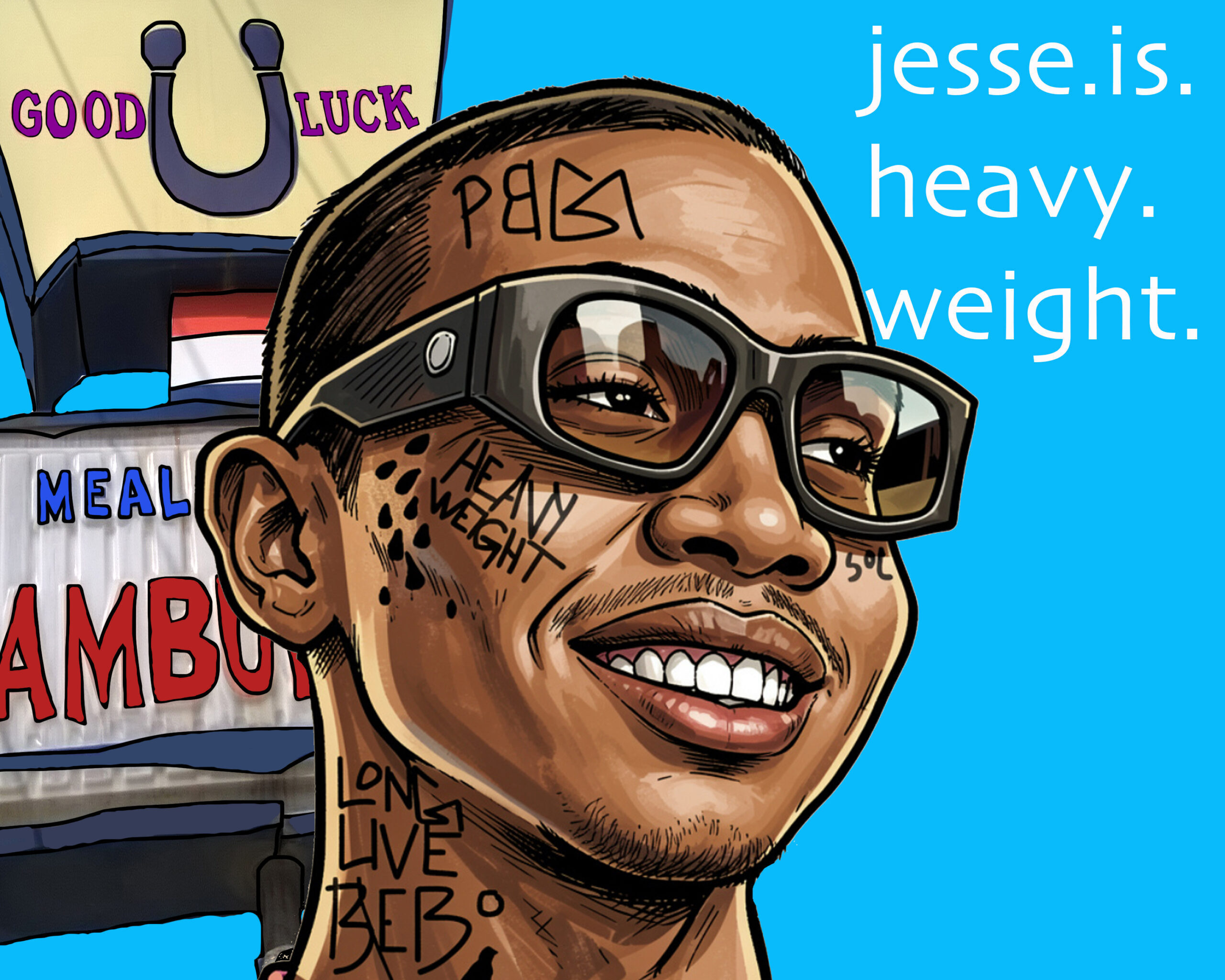
Nearly 10 million streams the first weekend of global release. More than 100,000 bracelets sold. A direct-to-fan empire years in the making. Jesse Is Heavyweight isn’t participating in the music business—he’s redesigning it.
Most artists spend their careers trying to build a fanbase. Jesse Is Heavyweight spent his building an infrastructure. That distinction is what makes Good Luck one of the most fascinating independent releases in recent memory.
The Juneteenth release has reportedly generated nearly 10 million streams on Apple Music while simultaneously fueling demand for the Good Luck bracelet, a product released through a partnership involving luxury fashion house TOIDI, Heavyweight Unlimited and Jesse Is Heavyweight. By itself, either accomplishment would be noteworthy.
Together, they suggest something much larger. This isn’t merely a successful album. It’s the latest chapter in a business philosophy Jesse Is Heavyweight has been developing for years.
BEFORE GOOD LUCK, THERE WAS HEAVYWEIGHT UNLIMITED
To understand Good Luck, you have to understand Heavyweight Unlimited.
According to The Source and All Hip Hop, Heavyweight Unlimited began as a music venture before evolving into a broader multimedia and entrepreneurial ecosystem spanning entertainment, fashion, technology, community initiatives and brand development. The organization describes itself as a modern multimedia conglomerate built around ownership, independence and long-term asset creation.
The story begins in South Oak Cliff, Dallas.
Long before the streaming numbers, business ventures and industry attention, Jesse Is Heavyweight was developing a reputation as a young artist and entrepreneur. Profiles trace his journey from the Dallas underground rap scene to Howard University, where he continued building what would eventually become the Heavyweight brand. Unlike many independent artists who seek validation through major-label partnerships, Jesse’s public identity has become closely associated with ownership.
Ownership of masters.
Ownership of distribution.
Ownership of audience relationships.
Ownership of brands.
That philosophy appears repeatedly throughout coverage of his career and forms the foundation upon which Good Luck was built.
THE GOOD LUCK STRATEGY
What makes Good Luck different isn’t simply the music. It’s the structure.
According to reporting, Jesse successfully experimented with premium direct-to-consumer releases, selling albums directly to fans while maintaining selective streaming distribution. One publication compared the economics of his direct-sales approach to tens of millions of Spotify streams, arguing that a smaller number of committed supporters can often generate more revenue than a massive audience of passive listeners. Good Luck appears to represent the fullest realization of that concept.
The music exists.
The bracelet exists.
The story exists.
The community exists.
Each component reinforces the others.
Instead of asking fans to simply consume a project, the release invites participation.
The result is a release strategy that resembles a startup launch as much as a traditional album rollout.
FROM MERCHANDISE TO MEANING
Historically, artists have sold products around music.
T-shirts.
Posters.
Vinyl.
Collectibles.
But the Good Luck bracelet is being positioned differently. Supporters describe it as a symbol attached to the message of the project itself rather than merely a souvenir from it.
That distinction may explain why the bracelet has become central to conversations surrounding the release. The most successful cultural symbols are rarely valuable because of what they cost.
They’re valuable because of what they represent. For supporters of Good Luck, the bracelet appears to function as a physical reminder of resilience, optimism and community.
THE POLITICS OF PRESENCE
The project’s dedication to Kohen Wylie gives Good Luck an emotional center that extends beyond entertainment. In an industry where many artists avoid politically sensitive issues, Jesse Is Heavyweight chose to place a tragedy involving a child at the forefront of the conversation surrounding the release.
Whether listeners agree with every aspect of that decision or not, it reflects a recurring pattern visible throughout his career: an interest in connecting music to larger social and community-oriented ideas. Recently he dedicated Vengeance Is God’s to the memory of Breonna Taylor and released a freestyle directly to Patreon that honored the Women of the Black Panther Party named 3:50 AM in Oakland. That willingness to engage difficult subjects has become part of the identity of both the artist and the broader Heavyweight ecosystem.
WHY THE INDUSTRY IS PAYING ATTENTION
The music industry has spent years asking the same question:
What comes after streaming?
Jesse Is Heavyweight’s answer appears to be ownership.
Not ownership as a slogan.
Ownership as a business model.
Heavyweight Unlimited ecosystem already includes media, fashion, technology initiatives and direct fan engagement channels. Good Luck demonstrates what happens when those components are activated simultaneously around a single release.
The album generates streams.
The bracelet generates commerce.
The story generates conversation.
The movement generates loyalty.
Each supports the others.
That level of integration is rare.
THE HEAVYWEIGHT VISION
Written, performed and designed by Jesse Is Heavyweight, Good Luck arrives as more than an album release.
It arrives as a case study.
A case study in ownership.
A case study in brand architecture.
A case study in direct-to-consumer culture building.
For years, Jesse Is Heavyweight has argued—through both words and business decisions—that artists should own more of the systems surrounding their work.
With Good Luck, he has delivered the clearest expression of that philosophy to date.
The streaming numbers will continue to grow.
The bracelet will continue to circulate.
The conversations will continue to evolve.
But perhaps the most important takeaway is this:
Good Luck is not being presented as a product.
It is being presented as a new world where tragedy doesn’t go underrepresented and artists can actually make great music.
And in modern entertainment, the creators who build worlds often end up shaping the future.